
Thermodynamic ligand profiling on a GPCR using Grating-Coupled Interferometry
Thermodynamic profiling looks beyond simple binding affinity (KD or IC50) and determines binding energy (ΔG) with its enthalpic (ΔH) and entropic (ΔS) components. This is relevant, as two compounds may have an identical affinity, but can have very different ΔH and ΔS contributions, which will influence how the compound behaves in development with respect to selectivity, susceptibility to resistance mutations, and the risk of off-target binding and side effects. Remarkably, best-in-class drugs, including e.g., statins and protease inhibitors, derive their high affinity and selectivity from favorable enthalpy (1). Therefore, beyond affinity and kinetic data, thermodynamic binding parameters provide valuable insight into ligand recognition mechanisms and support compound prioritization during hit-to-lead and lead optimization campaigns (2). When integrated with high-resolution structural information, drug discovery programs benefit from thermodynamic data through:
- Better lead selection
- Rational optimization potential
- De-risking selectivity problems
- Reducing attrition rate at later stages
However, membrane proteins, including GPCR, Ion Channels, Transporter, constitute the most important target classes in drug discovery, yet their biochemical complexity continues to challenge biophysical characterization. While isothermal titration calorimetry (ITC)remains a gold-standard technique, its application to membrane proteins is limited by high sample consumption, detergent background effects, and the need for highly concentrated, stable protein preparations (3). These challenges become particularly relevant for GPCRs and other membrane proteins that are difficult to express and purify in large quantities.
In this case study, leadXpro demonstrates the use of grating-coupled interferometry (GCI) for thermodynamic characterization of small molecule binding to the adenosine A2A receptor. Surface-based interaction analysis offers several advantages for membrane protein applications, including substantially reduced protein consumption, compatibility with detergent-solubilized targets, and the ability to generate high-quality kinetic and thermodynamic datasets.
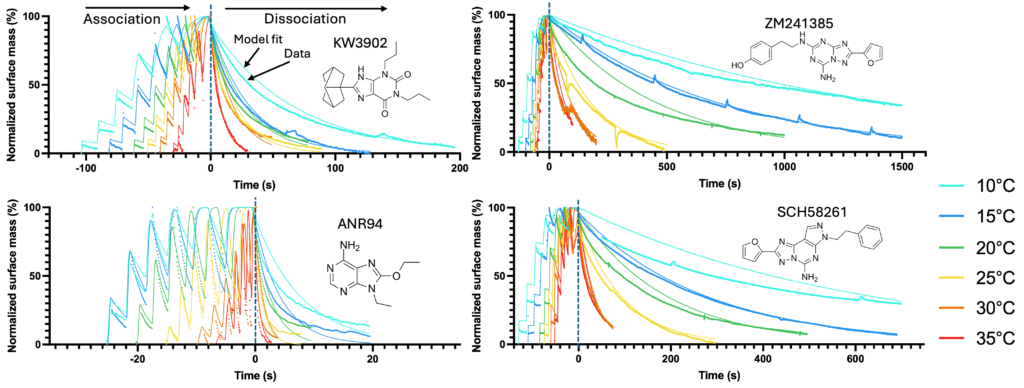
Interaction kinetics of four A2AR antagonists were determined in replicates at 6 temperatures from 10°C to 35°C using the GCI WAVEdelta system from Malvern Panalytical and the waveRAPID kinetics method (4). Injection pulsing and dissociation parameters were carefully optimized for each temperature to obtain high confidence temperature-dependent interaction data (Figure 1) and thermodynamic parameters were extracted from van’t Hoff analysis. Enthalpic (ΔH) and entropic (ΔS) components of the binding energy were derived by fitting the natural logarithm of the association constant, KA, as a function of inverse absolute temperature, 1/T, using a first-order van’t Hoff linear regression (Figure 2).

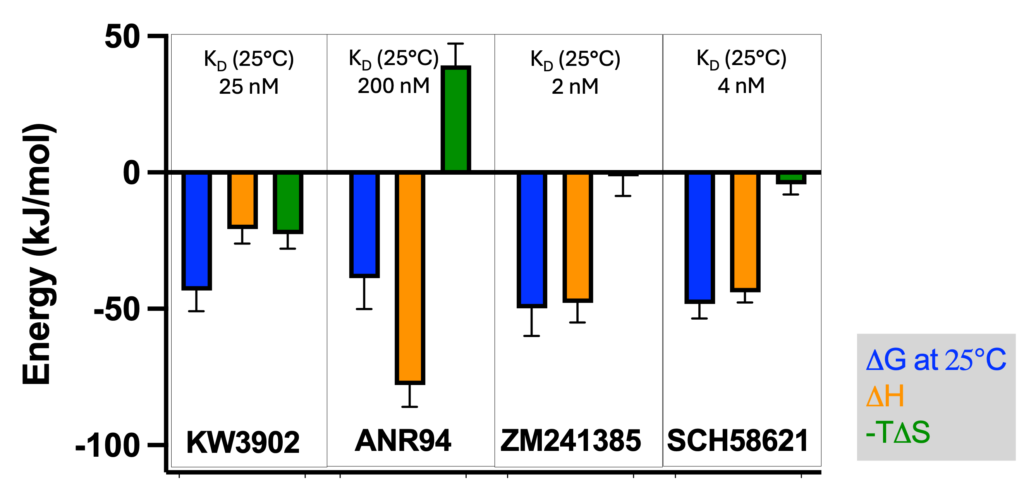
-TΔS (green). KD values at 25°C are indicated on top.
The four A2A receptor antagonists studied reveal distinct thermodynamic profiles: clearly enthalpy-driven binding for ZM241385 and SCH58621, a more balanced enthalpic/ entropic contribution for KW3902, and a strong enthalpic contribution offset by an entropic penalty for ANR94 (Figure 3). Among the four antagonists, ZM241385 and SCH58621 represent the two highest-affinity ligands (low nanomolar range), and their ΔG is almost entirely enthalpy-driven: essentially all the binding energy seems to derive from high-quality specific interactions (hydrogen bonds, polar contacts), with negligible entropic cost or gain. KW3902 shows a smaller ΔH than ZM241385 and SCH58621, but a favorable entropic contribution partially compensates for this reduction. This more balanced profile suggests that affinity arises from a combination of specific intermolecular interactions and a favorable entropic contribution – potentially reflecting partial hydrophobic burial or the release of ordered water – rather than being driven by enthalpy alone.
Here, ANR94 represents the mechanistically most interesting case: it displays by far the largest enthalpic contribution among the four compounds (≈ −80 kJ/mol), suggesting excellent surface complementarity between the ligand and the target, driven by an extensive network of specific contacts. This enthalpic gain, however, is almost entirely offset by a large unfavorable entropic penalty (≈ +45 kJ/mol); a textbook example of enthalpy–entropy compensation. The magnitude of ANR94’s enthalpic contribution supports the interpretation that it engages in an extensive and efficient network of specific interactions. Its comparatively lower overall affinity is therefore attributable not to a deficit in specific binding, but to the accompanying entropic cost. This distinction offers a mechanistically clean rationale for lead optimization: rather than introducing new interactions, optimizing ANR94 could instead focus on mitigating its entropic penalty – for example, by rigidifying the scaffold to reduce the conformational entropy loss upon binding, improving desolvation efficiency, or minimizing induced-fit penalties in the protein – while preserving the already favorable enthalpic network.
The development of tailored membrane protein assay conditions is of critical importance. The study highlights how robust surface-based assays can provide high-quality thermodynamic insight while maintaining manageable protein requirements. At leadXpro, we combine extensive expertise in membrane protein biochemistry, formulation development, and biophysical assay design to establish interaction assays adapted to the specific requirements of challenging targets, including GPCRs, transporters, ion channels, and other integral membrane proteins. Our integrated platform enables kinetic, affinity, stability, and structural biology workflows, using detergent-solubilized proteins, nanodiscs, and related membrane mimetic systems, to support drug discovery teams to identify best-in-class molecules.
Beyond that, thermodynamic profiling may also support AI-driven molecular design by providing interpretable data on the balance of enthalpic and entropic contributions to binding. Enthalpy-driven interactions may be particularly tractable for generative models, whereas solvent- and conformationally dominated entropy effects remain more difficult to predict reliably.
References
- E. Freire, “Do enthalpy and entropy distinguish first in class from best in class?,” Drug Discovery Today, vol. 13, no. 19-20, pp. 869-874, 2008.
- R. Claveria-Gimeno, “A look at ligand binding thermodynamics in drug discovery,” Expert Opinion Drug Discovery, pp. 363-377, 2017.
- K. Rajarathnam, “Isothermal titration calorimetry of membrane proteins — Progress and challenges,” Biochimica et Biophysica Acta (BBA) – Biomembranes, vol. Volume 1838, pp. 69-77, 2014.
- Ö. Kartal, “waveRAPID-A Robust Assay for High-Throughput Kinetic Screens with the Creoptix WAVEsystem,” SLAS Discovery, pp. 995-1003, 2021.
