
Functional and structural study on human SLC15A4
The solute carrier family 15 member 4 (SLC15A4, also known as PHT1) is a proton-coupled endolysosomal peptide transporter that translocates free histidine and certain dipeptides from the lysosome to cytosol. The transporter also binds to the immune adaptor TASL, facilitating activation of the transcription factor IRF5 during TLR signaling. This pathway has been implicated in autoimmune and inflammatory disease, most notably systemic lupus erythematosus (SLE).
At leadXpro, among many other challenging membrane protein (MP) targets, we established high quality protein production of human SLC15A4, several biophysical and biochemical assays, and a structure determination platform to study small molecule ligand binding to this challenging transporter.
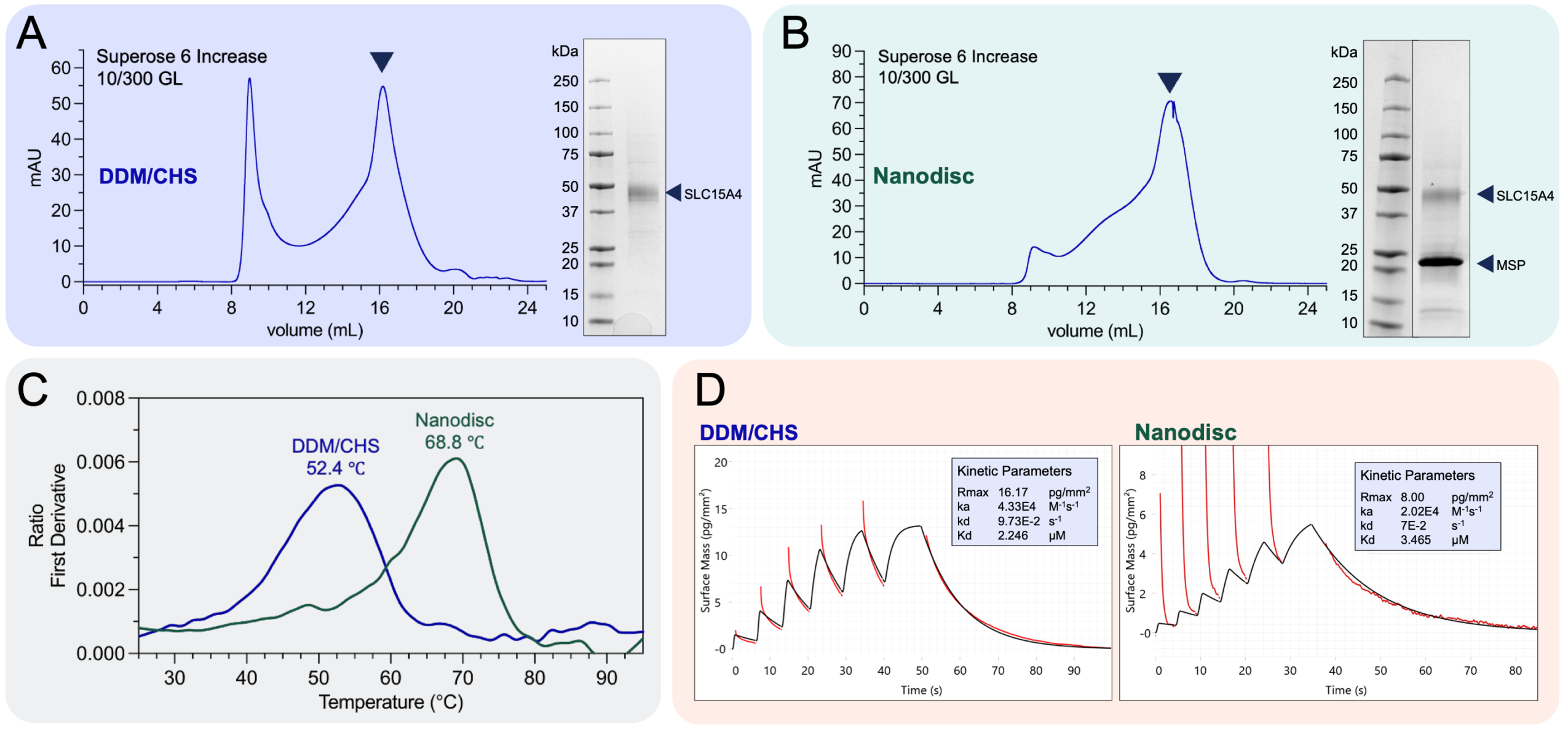
To facilitate correct protein glycosylation and maturation, we employ a mammalian expression system for recombinant expression of human SLC15A4. The optimized expression conditions not only provide high expression levels but have also been confirmed to produce active protein. Depending on the application of the purified protein, several different formulations can be used for in vitro studies. The two most common are detergent-based and lipid-filled nanodisc formulations (Fig. 1A,B). Based on nanoDSF measurements, the nanodisc formulation thermostabilizes human SLC15A4 by 16°C compared with the classic DDM/CHS formulation (Fig. 1C), but GCI ligand binding experiments confirm very similar affinity and binding kinetics.
Although this stabilizing effect may be advantageous for several studies, we always aim to alleviate bias arising from the chosen formulation. This is especially important when characterizing protein–ligand interactions by grating-coupled interferometry (GCI). Therefore, we immobilized SLC15A4 in both detergent and nanodisc formulations and showed that a model inhibitor binds to both samples with similar affinity, yielding comparable Kd values (Fig. 1D).
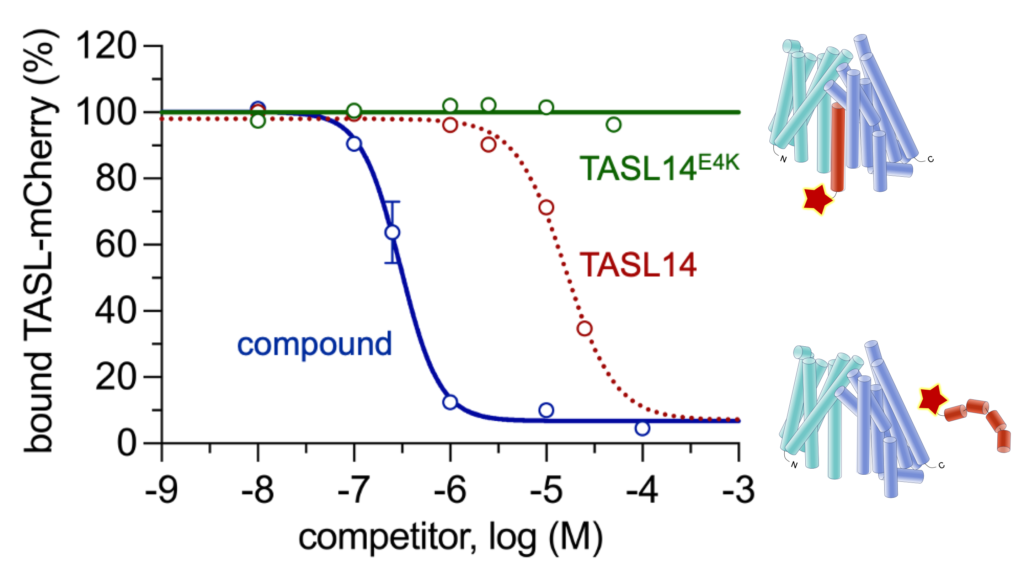
In parallel with the biophysical assay for kinetic characterization of small molecule ligands, leadXpro developed a biochemical assay to test complex formation between human SLC15A4 and mCherry-labelled TASL peptide, and to assess how competitors at varying concentrations inhibit this complex formation (Fig. 2). Both the positive and negative controls, non-labelled wild-type TASL and the non-labelled inactive TASL mutant (TASLE4K), respectively, confirmed the robustness of the assay. This allows us to analyze the inhibitory activity of compounds and determine their apparent Ki values.
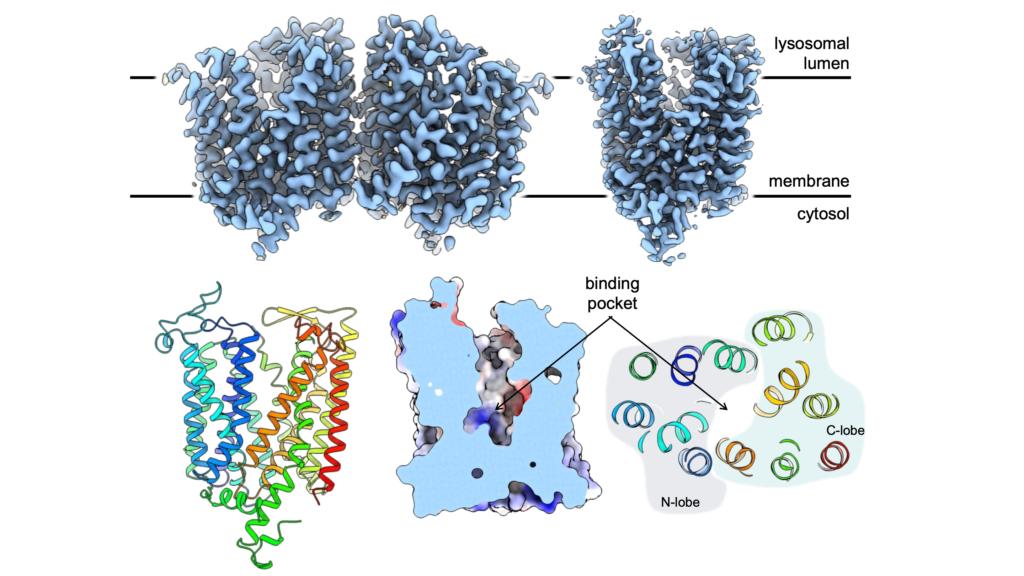
Leveraging leadXpro’s core expertise, we have also established a pipeline for high-resolution cryo-EM structure determination of human SLC15A4. Using fiducial markers, we are able to determine the near-atomic-resolution structure of the transporter in the outward-open conformation, i.e. with the substrate-binding cavity facing the lysosomal lumen. Interestingly, under certain conditions, we observe a dimeric form of the transporter (Fig. 3), however, no significant conformational differences are observed between the transporter structures determined from the monomeric and dimeric forms. SLC15A4 features a major facilitator superfamily (MFS) fold, characterized by 12 transmembrane helices forming two pseudo-symmetrical lobes. A key feature of the structure is a solvent-exposed, centrally located binding pocket (Fig. 3), which can accommodate different substrates and inhibitors.
The human SLC15 family is just one example of how leadXpro develops assay and structure platforms for the in vitro study of challenging membrane proteins. By combining expertise in protein science, biochemistry, biophysics and structural biology, we establish robust end-to-end workflows that enable protein production, functional characterization and high-resolution structure determination. These platforms provide a strong foundation for accelerating structure-based drug discovery programs across a broad range of membrane protein targets.
