
An integrated experimental and computational pipeline for crystallographic fragment screening of membrane protein in the lipid cubic phase
Chia-Ying Huang, Robert Cheng, Alexander Metz, Denis Bucher, Fabio Andres, Arianna Bacchin, Hannah Glover, Christoph Sager, Meitian Wang, Michel Steinmetz, Michael Hennig, and May Sharpe
In collaboration with the Paul Scherrer Institute (PSI) Center for Photon Sciences and Center for Life Sciences, leadXpro published the first large-scale LCP crystallographic fragment screening effort on a membrane protein.
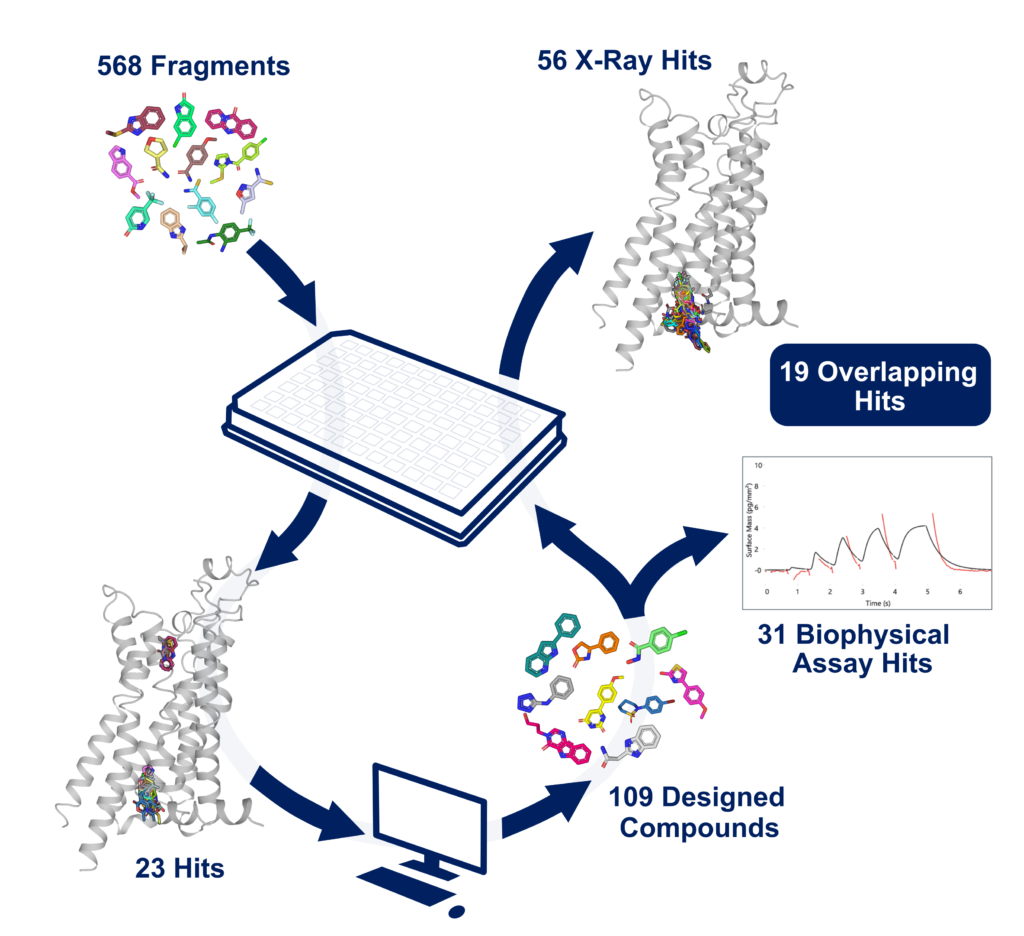
Using the human adenosine A₂A receptor (A2AR) as a model GPCR, the study grew crystals in lipidic cubic phase (LCP) and screened 568 fragments using an optimized and automated process at the Swiss Light Source (SLS) Synchrotron. This first screening round yielded 23 crystallographic fragment hits with observed ligand electron density. Three fragments bound to the known orthosteric ligand-binding site, while 20 unexpectedly occupied a novel intracellular binding pocket.
Read the full article here: C.Y. Huang et al. An integrated experimental and computational pipeline for crystallographic fragment screening of membrane protein in the lipid cubic phase. Commun. Chem. 2026, https://doi.org/10.1038/s42004-026-02059-7
The discovery of this intracellular site opens a new structure-guided design opportunity. Based on the experimentally observed fragment poses, tethered docking and virtual screening were applied to select 109 follow-up compounds. A second X-ray crystallographic screening campaign identified 56 compounds with clear binding poses, corresponding to a substantially enriched hit rate of 51%. The follow-up hits revealed conserved interaction patterns, including engagement of ASN39 and ASN42 within the intracellular pocket, and provided chemically diverse starting points for further ligand optimization.
leadXpro contributed to the experimental foundation of the work by producing the purified membrane protein and producing the crystals required for structural screening. leadXpro also contributed to the follow-up compound design by applying computational methods using the observed fragment poses to guide docking, fragment merging, and the selection of 109 diverse compounds targeting the intracellular pocket.
Furthermore, leadXpro executed and interpreted grating-coupled interferometry (GCI) measurements to biophysically assess the interaction of the follow-up compounds with A2AR. Following detailed evaluation of the GCI sensorgrams, 19 compounds showed consistent evidence of binding in both assays, with defined ligand electron density in X-ray structures and measurable target-engagement signals by GCI.
The study demonstrates that crystallographic fragment screening in LCP can be successfully implemented for GPCRs by combining high-resolution structural screening, computational design, and orthogonal biophysical validation. The workflow provides a powerful route for identifying novel chemical starting points for small-molecule hit discovery against challenging membrane protein drug targets.
