
GPR75: Making an Orphan Receptor Druggable
GPR75 is an orphan Class A GPCR with no validated endogenous ligand and presents significant challenges for protein production and biophysical characterization. Low expression levels and poor stability outside the membrane limit the generation of homogeneous, functional receptor preparations, restricting their application in biophysical ligand-binding methods and structural studies.
To enable drug discovery on this challenging target, we set out to establish GPR75 as a robust and tractable system for protein engineering, quantitative ligand binding, and structure determination. Our protein science platform generated and screened about 100 GPR75 constructs incorporating truncations, fusion partners, and targeted mutations to improve expression and stability. Protein quality assessment identified construct 39 as the lead variant, exhibiting a more homogeneous size-exclusion chromatography profile and enhanced thermal stability relative to wild-type (WT) GPR75.
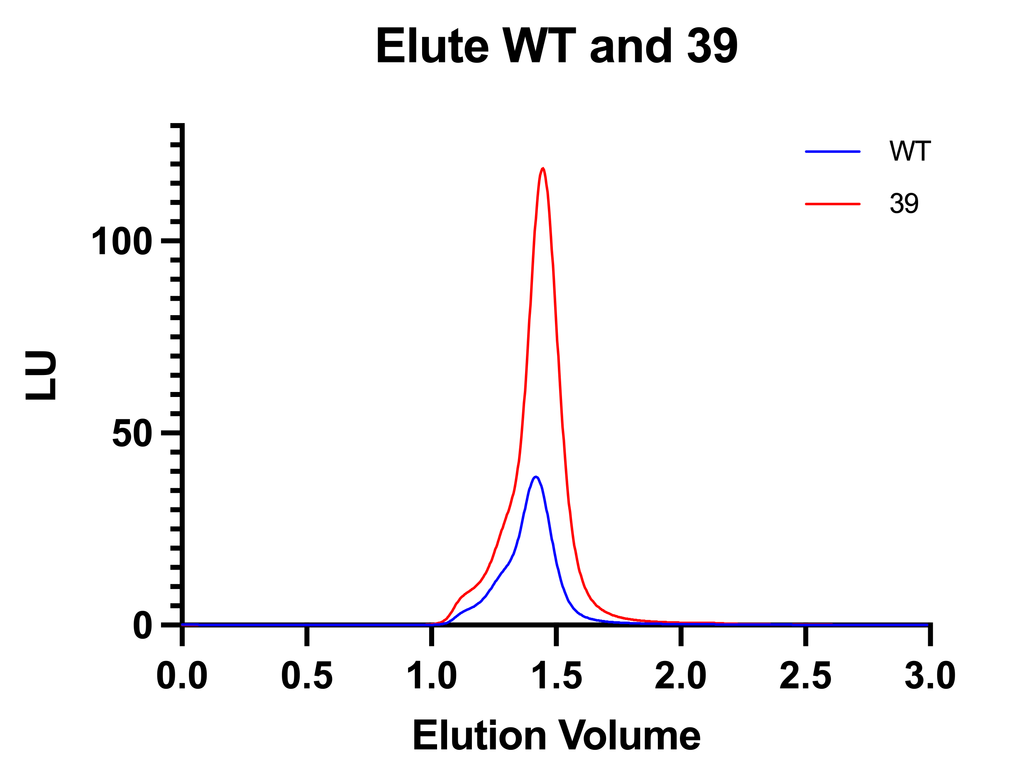
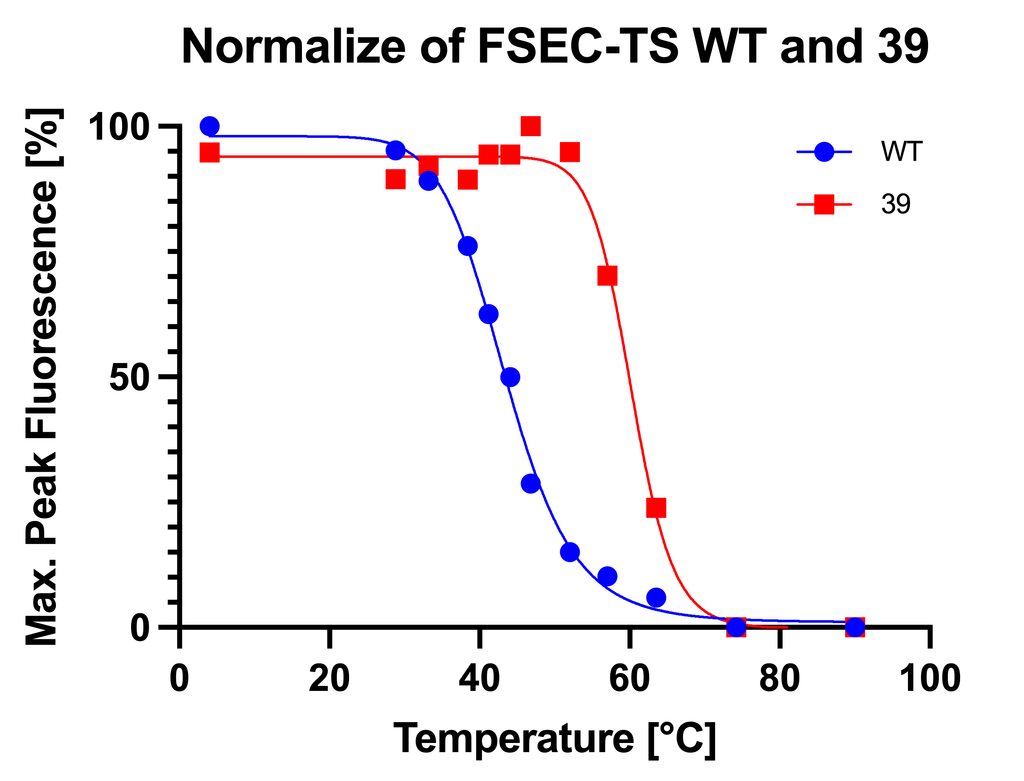
Figure 1. Sample quality and thermal stability of GPR75 variants. Fluorescence Size-Exclusion chromatography (FSEC) chromatograms comparing wild-type (WT) GPR75 and construct 39, demonstrating improved yield and monodispersity of construct 39 (left). Thermal Shift FSEC (FSEC-TS) analysis showing much enhanced thermal stability of construct 39 relative to WT (right).
Building on the improved biochemical properties of construct 39, we established a Grating-Coupled Interferometry (GCI) workflow for direct, label-free measurement of GPR75 ligand binding. The platform enabled quantitative determination of binding affinity and kinetic parameters, including association (kon) and dissociation (koff) rates, across a broad range of interaction strengths. Comparison of wild-type and thermostabilized GPR75 demonstrated reliable characterization of both reference tool compounds and weak HTS-derived hits with both proteins. Importantly, the thermostabilized construct maintained consistent ligand-binding activity over extended periods, supporting robust kinetic measurements and compound screening campaigns of several hundreds of ligands.
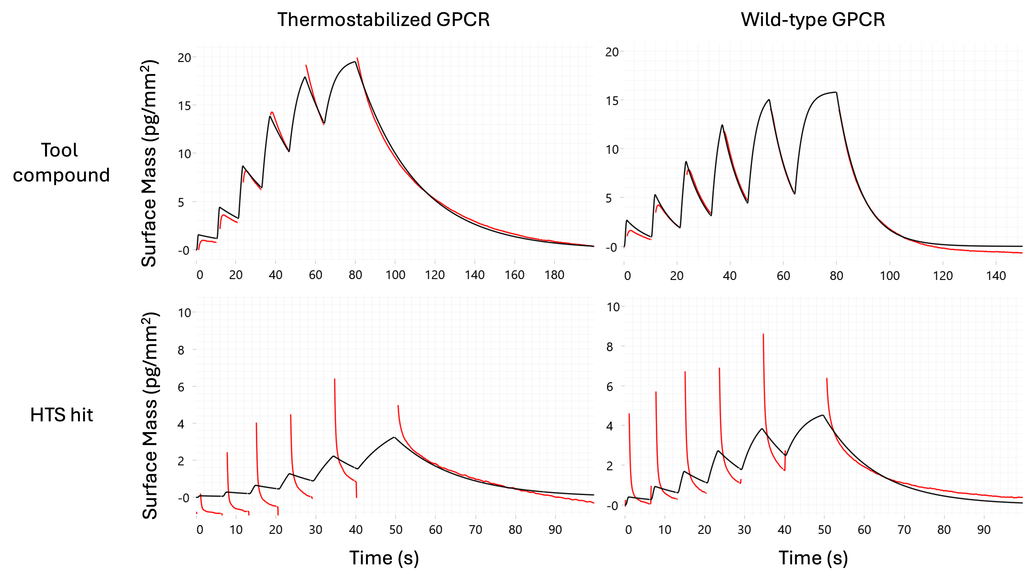
Figure 2. GCI-based characterization of ligand binding to wild-type and thermostabilized GPR75. Representative single-cycle (waveRAPID) sensorgrams and kinetic fits obtained for a reference tool compound and a weak HTS-derived hit using thermostabilized GPR75 (left) and wild-type (WT) GPR75 (right). The data demonstrate quantitative characterization of ligand-receptor interactions across a range of binding affinities and highlight the suitability of the engineered construct for robust binding analysis.

Figure 3. Functional stability of thermostabilized GPR75 immobilized on sensor surface. Repeated GCI sensorgrams collected using tool compound 2 demonstrate sustained ligand-binding activity of the thermostabilized GPR75 construct over several hours.
Structural biology provided the final layer of insight into GPR75 function. Using our cryo-EM platform, we determined structures of GPR75 in both inactive (antagonist-bound) and active (agonist-bound) conformations. The active-state structure captures GPR75 in complex with Gi, revealing the receptor-G protein interface and the molecular architecture underlying signal transduction. Comparison of the two states highlights the conformational changes associated with receptor activation and identifies structural features that may be exploited for ligand design. Together, these structures establish a framework for understanding binding-site recognition, receptor activation, and conformational selectivity, enabling structure-guided discovery and optimization of GPR75-targeted therapeutics.
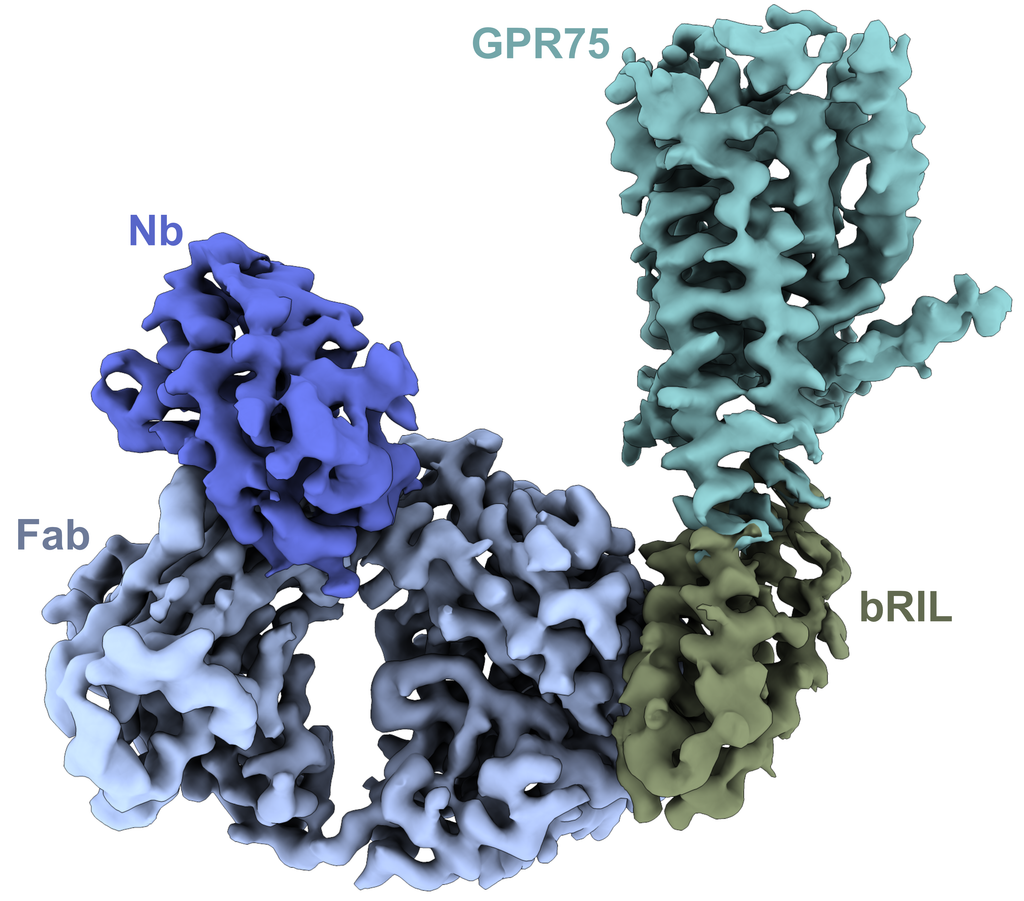
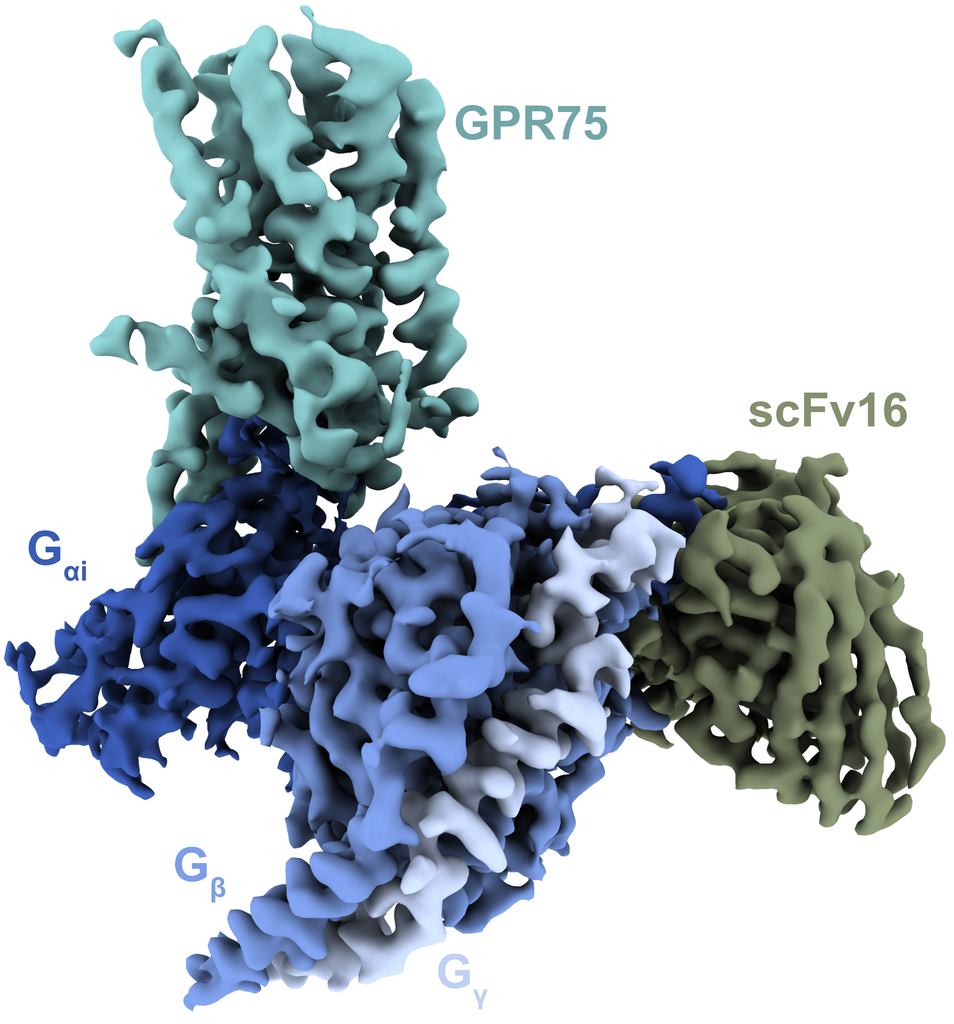
Figure 4. Structural basis of GPR75 activation. Cryo-EM structures of GPR75 captured in inactive (antagonist-bound, left) and active (agonist-bound, Gi-coupled, right) conformations, revealing the molecular changes underlying receptor activation and providing a framework for structure-guided drug discovery.